Chapter 1 a Review of General Chemistry Electrons Bonds and Molecular Properties Videos

Photo shows the nature of chemic bonds[i] in crystalline graphite by Electron cloud densitometry ρ(x,y).[2] The carbon atom is pinkish sphere of the ii inner electrons and four valence electrons: ii π bonds (blue color), which occurs laterally from graphite layer[3] and two strong σ bonds (green) in the shape of orbital hybrids. [four] Each carbon atom in graphite is known to have three sp² orbital hybrids, but the photo shows the edge of the crystal therefore the third hybrid cantlet is lacking.
A chemic bond is a lasting attraction between atoms, ions or molecules that enables the formation of chemical compounds. The bail may result from the electrostatic force between oppositely charged ions as in ionic bonds or through the sharing of electrons as in covalent bonds. The strength of chemical bonds varies considerably; there are "strong bonds" or "primary bonds" such as covalent, ionic and metallic bonds, and "weak bonds" or "secondary bonds" such as dipole–dipole interactions, the London dispersion forcefulness and hydrogen bonding.
Since opposite charges attract via a unproblematic electromagnetic force, the negatively charged electrons orbiting the nucleus and the positively charged protons in the nucleus attract each other. An electron positioned between ii nuclei will exist attracted to both of them, and the nuclei volition be attracted toward electrons in this position. This attraction constitutes the chemical bond.[one] Due to the matter wave nature of electrons and their smaller mass, they must occupy a much larger amount of volume compared with the nuclei, and this volume occupied by the electrons keeps the atomic nuclei in a bail relatively far apart, as compared with the size of the nuclei themselves.[5]
In general, strong chemical bonding is associated with the sharing or transfer of electrons between the participating atoms. The atoms in molecules, crystals, metals and diatomic gases—indeed most of the concrete environment around us—are held together by chemical bonds, which dictate the structure and the majority properties of affair.

Examples of Lewis dot-mode representations of chemical bonds between carbon (C), hydrogen (H), and oxygen (O). Lewis dot diagrams were an early attempt to depict chemical bonding and are however widely used today.
All bonds tin can exist explained by quantum theory, but, in practise, simplification rules allow chemists to predict the strength, directionality, and polarity of bonds. The octet rule and VSEPR theory are ii examples. More sophisticated theories are valence bond theory, which includes orbital hybridization[vi] and resonance,[vii] and molecular orbital theory[8] which includes linear combination of atomic orbitals and ligand field theory. Electrostatics are used to describe bond polarities and the effects they have on chemical substances.
Overview of main types of chemical bonds
A chemical bond is an allure between atoms. This attraction may be seen as the issue of different behaviors of the outermost or valence electrons of atoms. These behaviors merge into each other seamlessly in diverse circumstances, so that there is no clear line to be drawn between them. Nevertheless it remains useful and customary to differentiate between unlike types of bail, which result in different backdrop of condensed matter.
In the simplest view of a covalent bond, one or more electrons (frequently a pair of electrons) are drawn into the space between the two diminutive nuclei. Energy is released past bail germination.[nine] This is non as a result of reduction in potential energy, because the attraction of the ii electrons to the two protons is offset by the electron-electron and proton-proton repulsions. Instead, the release of energy (and hence stability of the bond) arises from the reduction in kinetic free energy due to the electrons being in a more spatially distributed (i.e. longer de Broglie wavelength) orbital compared with each electron being confined closer to its respective nucleus.[10] These bonds be betwixt 2 particular identifiable atoms and take a direction in space, allowing them to be shown every bit single connecting lines between atoms in drawings, or modeled as sticks between spheres in models.
In a polar covalent bond, i or more than electrons are unequally shared between two nuclei. Covalent bonds oft consequence in the formation of small collections of better-connected atoms called molecules, which in solids and liquids are bound to other molecules by forces that are often much weaker than the covalent bonds that concur the molecules internally together. Such weak intermolecular bonds give organic molecular substances, such as waxes and oils, their soft bulk grapheme, and their depression melting points (in liquids, molecules must cease most structured or oriented contact with each other). When covalent bonds link long bondage of atoms in large molecules, however (as in polymers such as nylon), or when covalent bonds extend in networks through solids that are non composed of discrete molecules (such as diamond or quartz or the silicate minerals in many types of stone) so the structures that result may be both strong and tough, at least in the direction oriented correctly with networks of covalent bonds.[xi] Also, the melting points of such covalent polymers and networks increase greatly.
In a simplified view of an ionic bond, the bonding electron is not shared at all, simply transferred. In this blazon of bond, the outer diminutive orbital of one atom has a vacancy which allows the addition of ane or more electrons. These newly added electrons potentially occupy a lower energy-state (effectively closer to more nuclear charge) than they experience in a different cantlet. Thus, one nucleus offers a more tightly bound position to an electron than does another nucleus, with the result that ane atom may transfer an electron to the other. This transfer causes one atom to assume a internet positive accuse, and the other to assume a net negative accuse. The bond then results from electrostatic attraction between the positive and negatively charged ions. Ionic bonds may be seen as farthermost examples of polarization in covalent bonds. Often, such bonds have no detail orientation in space, since they result from equal electrostatic attraction of each ion to all ions around them. Ionic bonds are strong (and thus ionic substances require high temperatures to melt) simply also brittle, since the forces between ions are curt-range and do non easily bridge cracks and fractures. This type of bail gives rise to the physical characteristics of crystals of classic mineral salts, such as table table salt.
A less oftentimes mentioned type of bonding is metallic bonding. In this blazon of bonding, each atom in a metallic donates ane or more electrons to a "body of water" of electrons that reside between many metal atoms. In this sea, each electron is gratis (by virtue of its wave nature) to be associated with a groovy many atoms at once. The bail results because the metal atoms become somewhat positively charged due to loss of their electrons while the electrons remain attracted to many atoms, without being part of any given atom. Metallic bonding may be seen as an farthermost example of delocalization of electrons over a large system of covalent bonds, in which every atom participates. This type of bonding is often very strong (resulting in the tensile strength of metals). Even so, metallic bonding is more commonage in nature than other types, then they allow metallic crystals to more easily deform, because they are equanimous of atoms attracted to each other, only not in whatever particularly-oriented ways. This results in the malleability of metals. The cloud of electrons in metallic bonding causes the characteristically good electric and thermal electrical conductivity of metals, and also their shiny lustre that reflects most frequencies of white light.
History
Early speculations about the nature of the chemical bail, from as early on as the twelfth century, supposed that certain types of chemic species were joined past a type of chemical analogousness. In 1704, Sir Isaac Newton famously outlined his atomic bonding theory, in "Query 31" of his Opticks, whereby atoms attach to each other by some "forcefulness". Specifically, after acknowledging the various popular theories in faddy at the time, of how atoms were reasoned to attach to each other, i.eastward. "hooked atoms", "glued together by residuum", or "stuck together by conspiring motions", Newton states that he would rather infer from their cohesion, that "particles attract 1 some other by some force, which in immediate contact is exceedingly stiff, at pocket-size distances performs the chemical operations, and reaches not far from the particles with any sensible issue."
In 1819, on the heels of the invention of the voltaic pile, Jöns Jakob Berzelius developed a theory of chemic combination stressing the electronegative and electropositive characters of the combining atoms. By the mid 19th century, Edward Frankland, F.A. Kekulé, A.S. Couper, Alexander Butlerov, and Hermann Kolbe, building on the theory of radicals, developed the theory of valency, originally called "combining power", in which compounds were joined owing to an attraction of positive and negative poles. In 1904, Richard Abegg proposed his rule that the difference between the maximum and minimum valencies of an element is often viii. At this point, valency was withal an empirical number based only on chemic properties.
However the nature of the cantlet became clearer with Ernest Rutherford's 1911 discovery that of an diminutive nucleus surrounded by electrons in which he quoted Nagaoka rejected Thomson'due south model on the grounds that opposite charges are impenetrable. In 1904, Nagaoka proposed an culling planetary model of the cantlet in which a positively charged center is surrounded by a number of revolving electrons, in the fashion of Saturn and its rings.[12]
Nagaoka'south model made two predictions:
- a very massive diminutive center (in illustration to a very massive planet)
- electrons revolving around the nucleus, bound by electrostatic forces (in analogy to the rings revolving around Saturn, bound by gravitational forces.)
Rutherford mentions Nagaoka's model in his 1911 paper in which the atomic nucleus is proposed.[13]
At the 1911 Solvay Conference, in the discussion of what could regulate energy differences betwixt atoms, Max Planck merely stated: "The intermediaries could be the electrons."[14] These nuclear models suggested that electrons make up one's mind chemic behavior.
Adjacent came Niels Bohr's 1913 model of a nuclear cantlet with electron orbits. In 1916, chemist Gilbert N. Lewis developed the concept of electron-pair bonds, in which two atoms may share 1 to six electrons, thus forming the single electron bond, a single bail, a double bond, or a triple bond; in Lewis'due south own words, "An electron may class a part of the trounce of two different atoms and cannot exist said to belong to either i exclusively."[fifteen]
As well in 1916, Walther Kossel put forrard a theory similar to Lewis' only his model assumed complete transfers of electrons betwixt atoms, and was thus a model of ionic bonding. Both Lewis and Kossel structured their bonding models on that of Abegg's rule (1904).
Niels Bohr also proposed a model of the chemical bond in 1913. According to his model for a diatomic molecule, the electrons of the atoms of the molecule form a rotating ring whose plane is perpendicular to the axis of the molecule and equidistant from the atomic nuclei. The dynamic equilibrium of the molecular organization is achieved through the balance of forces between the forces of allure of nuclei to the aeroplane of the ring of electrons and the forces of mutual repulsion of the nuclei. The Bohr model of the chemical bond took into account the Coulomb repulsion – the electrons in the ring are at the maximum distance from each other.[sixteen] [17]
In 1927, the first mathematically complete breakthrough description of a uncomplicated chemical bond, i.due east. that produced by 1 electron in the hydrogen molecular ion, H2 +, was derived by the Danish physicist Øyvind Burrau.[18] This work showed that the breakthrough approach to chemical bonds could be fundamentally and quantitatively correct, but the mathematical methods used could not be extended to molecules containing more than than one electron. A more practical, albeit less quantitative, approach was put forrard in the same yr by Walter Heitler and Fritz London. The Heitler–London method forms the basis of what is now chosen valence bail theory.[4] In 1929, the linear combination of atomic orbitals molecular orbital method (LCAO) approximation was introduced by Sir John Lennard-Jones, who besides suggested methods to derive electronic structures of molecules of F2 (fluorine) and O2 (oxygen) molecules, from basic quantum principles. This molecular orbital theory represented a covalent bond as an orbital formed by combining the breakthrough mechanical Schrödinger atomic orbitals which had been hypothesized for electrons in single atoms. The equations for bonding electrons in multi-electron atoms could non be solved to mathematical perfection (i.eastward., analytically), only approximations for them yet gave many skillful qualitative predictions and results. About quantitative calculations in modern quantum chemistry use either valence bond or molecular orbital theory equally a starting point, although a tertiary arroyo, density functional theory, has become increasingly pop in contempo years.
In 1933, H. H. James and A. S. Coolidge carried out a calculation on the dihydrogen molecule that, unlike all previous calculation which used functions simply of the distance of the electron from the atomic nucleus, used functions which likewise explicitly added the distance between the two electrons.[nineteen] With upwardly to 13 adjustable parameters they obtained a result very close to the experimental upshot for the dissociation energy. Later extensions take used up to 54 parameters and gave first-class agreement with experiments. This calculation convinced the scientific community that quantum theory could requite agreement with experiment. However this approach has none of the physical pictures of the valence bond and molecular orbital theories and is hard to extend to larger molecules.
Bonds in chemical formulas
Considering atoms and molecules are three-dimensional, it is difficult to use a single method to bespeak orbitals and bonds. In molecular formulas the chemical bonds (bounden orbitals) between atoms are indicated in dissimilar means depending on the type of word. Sometimes, some details are neglected. For example, in organic chemistry one is sometimes concerned merely with the functional group of the molecule. Thus, the molecular formula of ethanol may be written in conformational form, 3-dimensional form, full two-dimensional grade (indicating every bond with no three-dimensional directions), compressed two-dimensional course (CHiii–CH2–OH), past separating the functional group from another role of the molecule (C2H5OH), or by its diminutive constituents (C2Hhalf-dozenO), according to what is discussed. Sometimes, even the non-bonding valence shell electrons (with the two-dimensional approximate directions) are marked, e.g. for elemental carbon . 'C'. Some chemists may likewise mark the corresponding orbitals, e.g. the hypothetical ethene−4 anion (\ /C=C/ \ −4) indicating the possibility of bond formation.
Strong chemical bonds
| Typical bond lengths in pm and bond energies in kJ/mol. [20] Bond lengths tin can be converted to Å by segmentation by 100 (1 Å = 100 pm). | ||
| Bond | Length (pm) | Free energy (kJ/mol) |
|---|---|---|
| H — Hydrogen | ||
| H–H | 74 | 436 |
| H–O | 96 | 467 |
| H–F | 92 | 568 |
| H–Cl | 127 | 432 |
| C — Carbon | ||
| C–H | 109 | 413 |
| C–C | 154 | 347 |
| C–C= | 151 | |
| =C–C≡ | 147 | |
| =C–C= | 148 | |
| C=C | 134 | 614 |
| C≡C | 120 | 839 |
| C–N | 147 | 308 |
| C–O | 143 | 358 |
| C=O | 745 | |
| C≡O | 1,072 | |
| C–F | 134 | 488 |
| C–Cl | 177 | 330 |
| N — Nitrogen | ||
| N–H | 101 | 391 |
| N–Northward | 145 | 170 |
| Due north≡N | 110 | 945 |
| O — Oxygen | ||
| O–O | 148 | 146 |
| O=O | 121 | 495 |
| F, Cl, Br, I — Halogens | ||
| F–F | 142 | 158 |
| Cl–Cl | 199 | 243 |
| Br–H | 141 | 366 |
| Br–Br | 228 | 193 |
| I–H | 161 | 298 |
| I–I | 267 | 151 |
Strong chemical bonds are the intramolecular forces that hold atoms together in molecules. A strong chemical bond is formed from the transfer or sharing of electrons between diminutive centers and relies on the electrostatic attraction between the protons in nuclei and the electrons in the orbitals.
The types of strong bond differ due to the departure in electronegativity of the constituent elements. Electronegativity is the trend for an atom of a given chemical element to concenter shared electrons when forming a chemical bail, where the higher the associated electronegativity and so the more it attracts electrons. Electronegativity serves as a simple way to quantitatively estimate the bond free energy, which characterizes a bond forth the continuous scale from covalent to ionic bonding. A big difference in electronegativity leads to more polar (ionic) character in the bail.
Ionic bond
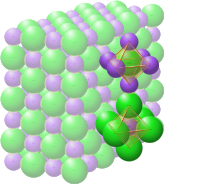
Ionic bonding is a blazon of electrostatic interaction between atoms that have a large electronegativity difference. There is no precise value that distinguishes ionic from covalent bonding, simply an electronegativity divergence of over ane.7 is likely to be ionic while a deviation of less than 1.7 is likely to be covalent.[21] Ionic bonding leads to carve up positive and negative ions. Ionic charges are commonly between −3e to +3e. Ionic bonding commonly occurs in metal salts such as sodium chloride (table salt). A typical feature of ionic bonds is that the species form into ionic crystals, in which no ion is specifically paired with any single other ion in a specific directional bond. Rather, each species of ion is surrounded past ions of the opposite charge, and the spacing betwixt it and each of the oppositely charged ions near information technology is the same for all surrounding atoms of the same type. It is thus no longer possible to associate an ion with whatever specific other single ionized cantlet near it. This is a state of affairs dissimilar that in covalent crystals, where covalent bonds betwixt specific atoms are even so discernible from the shorter distances between them, as measured via such techniques every bit X-ray diffraction.
Ionic crystals may contain a mixture of covalent and ionic species, as for example salts of complex acids such every bit sodium cyanide, NaCN. X-ray diffraction shows that in NaCN, for instance, the bonds between sodium cations (Na+) and the cyanide anions (CN−) are ionic, with no sodium ion associated with any particular cyanide. However, the bonds between the carbon (C) and nitrogen (N) atoms in cyanide are of the covalent type, then that each carbon is strongly bound to just one nitrogen, to which it is physically much closer than it is to other carbons or nitrogens in a sodium cyanide crystal.
When such crystals are melted into liquids, the ionic bonds are broken beginning because they are non-directional and allow the charged species to movement freely. Similarly, when such salts dissolve into water, the ionic bonds are typically broken by the interaction with water simply the covalent bonds continue to agree. For example, in solution, the cyanide ions, still bound together equally single CN− ions, move independently through the solution, as do sodium ions, equally Na+. In h2o, charged ions move autonomously because each of them are more strongly attracted to a number of water molecules than to each other. The attraction between ions and water molecules in such solutions is due to a type of weak dipole-dipole type chemical bond. In melted ionic compounds, the ions keep to exist attracted to each other, simply not in whatever ordered or crystalline way.
Covalent bond
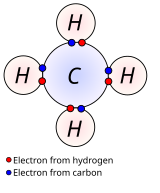
Covalent bonding is a common type of bonding in which 2 or more atoms share valence electrons more or less every bit. The simplest and most common type is a single bond in which 2 atoms share ii electrons. Other types include the double bond, the triple bond, 1- and 3-electron bonds, the iii-center ii-electron bond and three-center four-electron bail.
In non-polar covalent bonds, the electronegativity difference between the bonded atoms is small, typically 0 to 0.3. Bonds within almost organic compounds are described as covalent. The figure shows marsh gas (CH4), in which each hydrogen forms a covalent bond with the carbon. See sigma bonds and pi bonds for LCAO descriptions of such bonding.[22]
Molecules that are formed primarily from non-polar covalent bonds are often immiscible in water or other polar solvents, but much more than soluble in non-polar solvents such as hexane.
A polar covalent bond is a covalent bond with a pregnant ionic character. This means that the two shared electrons are closer to one of the atoms than the other, creating an imbalance of accuse. Such bonds occur between two atoms with moderately different electronegativities and give ascension to dipole–dipole interactions. The electronegativity difference between the 2 atoms in these bonds is 0.3 to 1.7.
Single and multiple bonds
A single bond between two atoms corresponds to the sharing of 1 pair of electrons. The Hydrogen (H) cantlet has one valence electron. Two Hydrogen atoms can then form a molecule, held together past the shared pair of electrons. Each H atom at present has the noble gas electron configuration of helium (He). The pair of shared electrons forms a unmarried covalent bond. The electron density of these two bonding electrons in the region between the two atoms increases from the density of two non-interacting H atoms.

Two p-orbitals forming a pi-bond.
A double bond has ii shared pairs of electrons, one in a sigma bond and one in a pi bail with electron density full-bodied on 2 contrary sides of the internuclear axis. A triple bond consists of iii shared electron pairs, forming one sigma and 2 pi bonds. An example is nitrogen. Quadruple and college bonds are very rare and occur simply between certain transition element atoms.
Coordinate covalent bond (dipolar bond)

Adduct of ammonia and boron trifluoride
A coordinate covalent bond is a covalent bond in which the two shared bonding electrons are from the same i of the atoms involved in the bail. For case, boron trifluoride (BF3) and ammonia (NH3) form an adduct or coordination complex F3B←NH3 with a B–Due north bond in which a solitary pair of electrons on N is shared with an empty atomic orbital on B. BF3 with an empty orbital is described every bit an electron pair acceptor or Lewis acrid, while NH3 with a solitary pair that can be shared is described equally an electron-pair donor or Lewis base of operations. The electrons are shared roughly equally between the atoms in contrast to ionic bonding. Such bonding is shown by an arrow pointing to the Lewis acid.
Transition element complexes are generally bound by coordinate covalent bonds. For example, the ion Ag+ reacts as a Lewis acid with two molecules of the Lewis base NHthree to form the complex ion Ag(NH3)2 +, which has two Ag←N coordinate covalent bonds.
Metallic bonding
In metallic bonding, bonding electrons are delocalized over a lattice of atoms. Past contrast, in ionic compounds, the locations of the binding electrons and their charges are static. The gratis motion or delocalization of bonding electrons leads to classical metallic properties such as luster (surface light reflectivity), electrical and thermal conductivity, ductility, and high tensile strength.
Intermolecular bonding
There are four basic types of bonds that can be formed between 2 or more (otherwise not-associated) molecules, ions or atoms. Intermolecular forces crusade molecules to be attracted or repulsed by each other. Often, these define some of the concrete characteristics (such as the melting point) of a substance.
- A large divergence in electronegativity between two bonded atoms will cause a permanent charge separation, or dipole, in a molecule or ion. Two or more molecules or ions with permanent dipoles tin collaborate within dipole-dipole interactions. The bonding electrons in a molecule or ion will, on average, exist closer to the more electronegative cantlet more ofttimes than the less electronegative i, giving rising to partial charges on each cantlet and causing electrostatic forces between molecules or ions.
- A hydrogen bond is finer a strong case of an interaction between 2 permanent dipoles. The large divergence in electronegativities between hydrogen and any of fluorine, nitrogen and oxygen, coupled with their lone pairs of electrons, cause potent electrostatic forces between molecules. Hydrogen bonds are responsible for the high boiling points of water and ammonia with respect to their heavier analogues.
- The London dispersion force arises due to instantaneous dipoles in neighbouring atoms. As the negative charge of the electron is not uniform around the whole cantlet, at that place is always a charge imbalance. This small charge will induce a respective dipole in a nearby molecule, causing an attraction between the two. The electron then moves to another part of the electron cloud and the allure is broken.
- A cation–pi interaction occurs between a pi bond and a cation.
Theories of chemic bonding
In the (unrealistic) limit of "pure" ionic bonding, electrons are perfectly localized on one of the ii atoms in the bond. Such bonds can exist understood by classical physics. The forces between the atoms are characterized past isotropic continuum electrostatic potentials. Their magnitude is in uncomplicated proportion to the accuse difference.
Covalent bonds are better understood by valence bail (VB) theory or molecular orbital (MO) theory. The properties of the atoms involved can be understood using concepts such equally oxidation number, formal charge, and electronegativity. The electron density within a bond is not assigned to individual atoms, simply is instead delocalized between atoms. In valence bond theory, bonding is conceptualized as being built upwardly from electron pairs that are localized and shared past ii atoms via the overlap of atomic orbitals. The concepts of orbital hybridization and resonance augment this basic notion of the electron pair bond. In molecular orbital theory, bonding is viewed as being delocalized and apportioned in orbitals that extend throughout the molecule and are adjusted to its symmetry backdrop, typically by considering linear combinations of atomic orbitals (LCAO). Valence bail theory is more chemically intuitive by being spatially localized, allowing attention to be focused on the parts of the molecule undergoing chemical change. In dissimilarity, molecular orbitals are more "natural" from a quantum mechanical point of view, with orbital energies beingness physically pregnant and directly linked to experimental ionization energies from photoelectron spectroscopy. Consequently, valence bond theory and molecular orbital theory are often viewed as competing but complementary frameworks that offer different insights into chemic systems. As approaches for electronic structure theory, both MO and VB methods can give approximations to any desired level of accurateness, at least in principle. Nevertheless, at lower levels, the approximations differ, and one approach may be meliorate suited for computations involving a detail system or holding than the other.
Unlike the spherically symmetrical Coulombic forces in pure ionic bonds, covalent bonds are more often than not directed and anisotropic. These are often classified based on their symmetry with respect to a molecular plane every bit sigma bonds and pi bonds. In the full general example, atoms form bonds that are intermediate between ionic and covalent, depending on the relative electronegativity of the atoms involved. Bonds of this type are known equally polar covalent bonds.
Run into besides
- Bail energy
- Covalent bond
- Halogen bond
- Hydrogen bond
- Ionic bonding
- Metallic bonding
- Pi bond
- Sigma bond
- 3-center four-electron bail
- Iii-eye two-electron bond
- van der Waals force
References
- ^ a b Pauling, Linus (1960). The Nature of the Chemic Bond. Cornell University Press. pp. 5–10. ISBN978-0-8014-0333-0. OCLC 17518275.
- ^ Kucherov, O. P.; Rud, A.D. (2018). "Directly visualization of individual molecules in molecular crystals past electron deject densitometry". Molecular Crystals and Liquid Crystals. 674 (1): 40–47. doi:ten.1080/15421406.2019.1578510. S2CID 198335705. t
- ^ Rud, Alexander D.; Kornienko, Nikolay Eastward.; Kirian, Inna One thousand.; Kirichenko, Alexey N; Kucherov, O. P. (2018). "Local heteroallotropic structures of carbon". Materials Today: Proceedings. five (12): 26089–26095. doi:10.1016/j.matpr.2018.08.035.
- ^ a b Heitler, West.; London, F. (1927). "Wechselwirkung neutraler Atome und homoopolare Bindung nach der Quantenmechanik" [Interaction of neutral atoms and homeopolar bonds according to quantum mechanics]. Zeitschrift für Physik. 44 (6–seven): 455–472. Bibcode:1927ZPhy...44..455H. doi:ten.1007/bf01397394. S2CID 119739102. English translation in Hettema, H. (2000). Quantum Chemistry: Archetype Scientific Papers. Globe Scientific. p. 140. ISBN978-981-02-2771-5 . Retrieved 2012-02-05 .
- ^ Pauling, Fifty. (1931), "The nature of the chemical bail. Application of results obtained from the quantum mechanics and from a theory of paramagnetic susceptibility to the construction of molecules", Journal of the American Chemic Order, 53 (4): 1367–1400, doi:10.1021/ja01355a027
- ^ Jensen, Frank (1999). Introduction to Computational Chemistry. John Wiley and Sons. ISBN978-0-471-98425-2.
- ^ Pauling, Linus (1960). "The Concept of Resonance". The Nature of the Chemical Bond – An Introduction to Mod Structural Chemical science (3rd ed.). Cornell Academy Printing. pp. ten–13. ISBN978-0801403330.
- ^ Gillespie, R.J. (2004), "Teaching molecular geometry with the VSEPR model", Periodical of Chemical Education, 81 (iii): 298–304, Bibcode:2004JChEd..81..298G, doi:10.1021/ed081p298
- ^ Housecroft, Catherine East.; Sharpe, Alan M. (2005). Inorganic Chemical science (second ed.). Pearson Prentice-Hal. p. 100. ISBN0130-39913-2.
- ^ Rioux, F. (2001). "The Covalent Bond in H2". The Chemic Educator. vi (5): 288–290. doi:10.1007/s00897010509a. S2CID 97871973.
- ^ Housecroft, Catherine E.; Sharpe, Alan Grand. (2005). Inorganic Chemical science (2nd ed.). Pearson Prentice-Hal. p. 100. ISBN0130-39913-two.
- ^ B. Bryson (2003). A Short History of Nearly Everything. Broadway Books. ISBN0-7679-0817-1.
- ^ The Genesis of the Bohr Atom, John L. Heilbron and Thomas S. Kuhn, Historical Studies in the Physical Sciences, Vol. i (1969), pp. vi, 211-290 (81 pages), University of California Press.
- ^ Original Proceedings of the 1911 Solvay Conference published 1912. THÉORIE DU RAYONNEMENT ET LES QUANTA. RAPPORTS ET DISCUSSIONS DELA Réunion tenue à Bruxelles, du 30 octobre au three novembre 1911, Sous les Auspices dk G. E. SOLVAY. Publiés par MM. P. LANGEVIN et M. de BROGLIE. Translated from the French, p. 127.
- ^ Lewis, Gilbert N. (1916). "The Cantlet and the Molecule". Journal of the American Chemical Gild. 38 (four): 772. doi:10.1021/ja02261a002. a copy
- ^ Pais, Abraham (1986). Inward Spring: Of Matter and Forces in the Physical World. New York: Oxford University Printing. pp. 228–230. ISBN978-0-19-851971-3.
- ^ Svidzinsky, Anatoly A.; Marlan O. Scully; Dudley R. Herschbach (2005). "Bohr's 1913 molecular model revisited". Proceedings of the National Academy of Sciences. 102 (34 [1]): 11985–11988. arXiv:physics/0508161. Bibcode:2005PNAS..10211985S. doi:10.1073/pnas.0505778102. PMC1186029. PMID 16103360.
- ^ Laidler, K. J. (1993). The World of Physical Chemistry . Oxford University Press. p. 346. ISBN978-0-19-855919-1.
- ^ James, H.H.; Coolidge, A S. (1933). "The Basis State of the Hydrogen Molecule". Journal of Chemical Physics. i (12): 825–835. Bibcode:1933JChPh...one..825J. doi:ten.1063/ane.1749252.
- ^ "Bond Energies". Chemistry Libre Texts. 2 October 2013. Retrieved 2019-02-25 .
- ^ Atkins, Peter; Loretta Jones (1997). Chemistry: Molecules, Affair and Change. New York: W.H. Freeman & Co. pp. 294–295. ISBN978-0-7167-3107-eight.
- ^ Streitwieser, Andrew; Heathcock, Clayton H.; Kosower, Edward 1000. (1992). Introduction to organic chemistry . Heathcock, Clayton H., Kosower, Edward Chiliad. (4th ed.). New York: Macmillan. pp. 250. ISBN978-0024181701. OCLC 24501305.
External links
- W. Locke (1997). Introduction to Molecular Orbital Theory. Retrieved May xviii, 2005.
- Carl R. Nave (2005). HyperPhysics. Retrieved May 18, 2005.
- Linus Pauling and the Nature of the Chemical Bond: A Documentary History. Retrieved February 29, 2008.
Source: https://en.wikipedia.org/wiki/Chemical_bond
0 Response to "Chapter 1 a Review of General Chemistry Electrons Bonds and Molecular Properties Videos"
Post a Comment