Ancient Greece Drama How It Traslates Into Art Today
/https://tf-cmsv2-smithsonianmag-media.s3.amazonaws.com/filer/f3/9c/f39cb745-e3fa-4282-8455-9667a173bcb2/antigoneferguson021.jpg)
Make them wish they'd never come,the director says, nigh absently. He means the audience. The actress nods. She makes a mark in her script next to the stage management:
[An inhuman weep]
And they go on rehearsing. The room is placidity. Belatedly afternoon light angles across the floor.
An hour later on from the phase her terrible howl rises over the audience to the ceiling, ringing against the walls and out the doors and down the stairs; rises from somewhere within her to fill the building and the streets and the sky with her pain and her anger and her sadness. It is a terrifying sound, not considering information technology is inhuman, but because it is likewise human being. Information technology is the sound non just of shock and of loss just of every shock and of every loss, of a grief beyond language understood everywhere past everyone.
The audience shifts uncomfortably in their seats. Then silence covers them all. This is the moment the director wanted, the moment of maximum discomfort. This is where the healing starts.
Later, the audience starts talking. They won't cease.
"I don't know what happened," the extra will say in a few days. "That reading, that particular nighttime, broke open a lot of people. And in a great way."
This is Theater of State of war.
The creation of director and co-founder Bryan Doerries, Brooklyn-based Theater of State of war Productions bills itself as "an innovative public health project that presents readings of ancient Greek plays, including Sophocles' Ajax, as a goad for town hall discussions about the challenges faced by service men and women, veterans, their families, caregivers and communities."
And tonight in the Milbank Chapel of Teachers College at Columbia University, they've washed just that, performing Ajax for a roomful of veterans and mental health professionals. Player Chris Henry Coffey reads Ajax. The scream came from Gloria Reuben, the actress playing Tecmessa, Ajax's wife.
Sophocles wrote the play 2,500 years ago, during a century of state of war and plague in Greece. It was part of the spring Urban center Dionysia, the dramatic festival of Athens at which the great tragedies and comedies of the age were performed for every citizen. Information technology is the wrenching story of the famed Greek warrior Ajax, betrayed and humiliated past his own generals, wearied by war, undone by violence and pride and fate and hopelessness until at last, seeing no fashion forrad, he takes his ain life.
**********
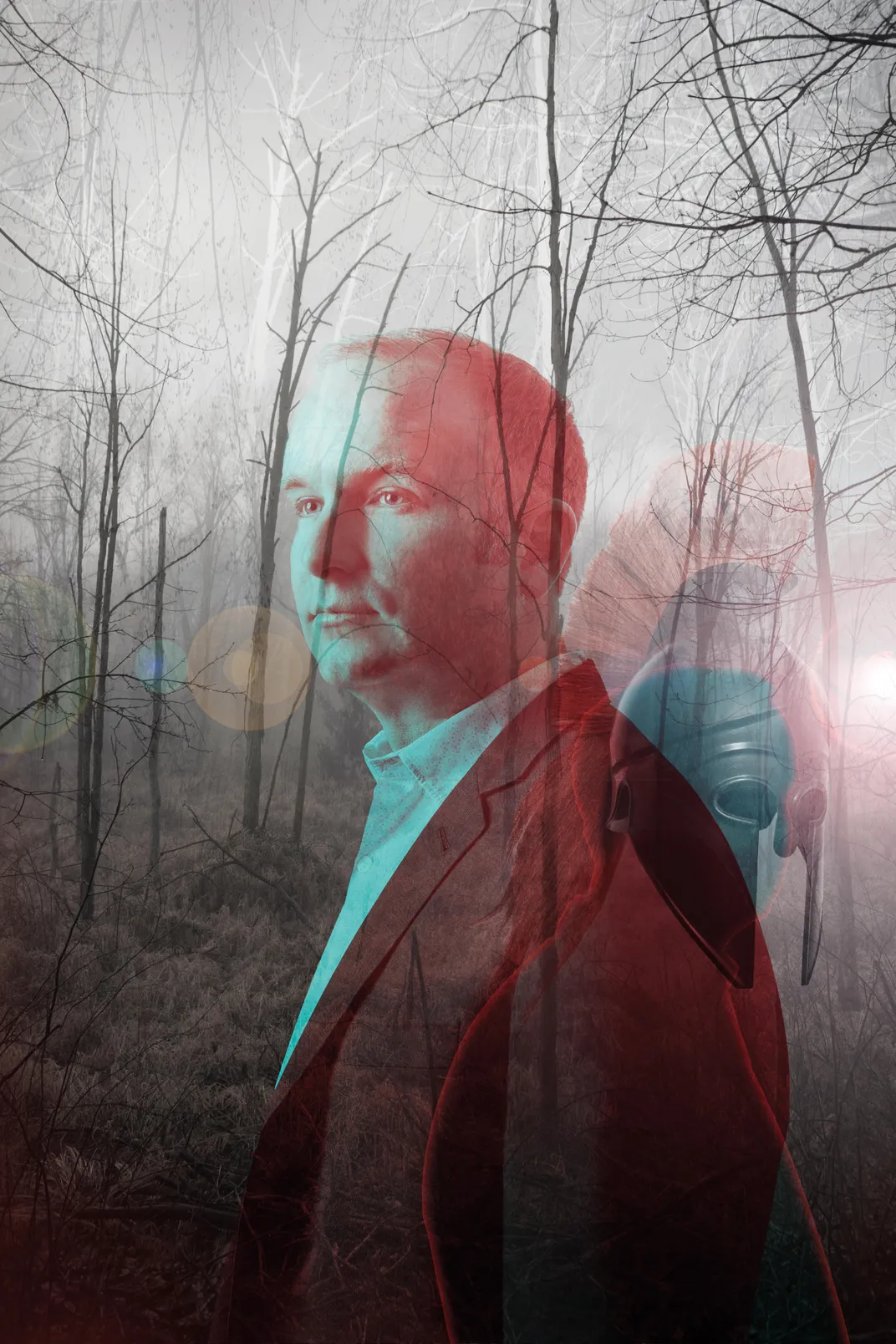
Doerries, 41, slim and earnest, energetic, explains all this to the audience that night. As he sometimes does, he will read the role of the chorus, too. He promises that the important work of discovery and empathy will brainstorm during the discussion post-obit the reading. The play is just the vehicle they'll use to get in that location.
A self-described classics nerd, Doerries was born and raised in Newport News, Virginia. His parents were both psychologists. A smart kid in a smart household, he appeared in his first Greek play at the age of 8, as one of the children in Euripides'Medea. He'll tell you it was a seminal experience. "I was i of the children who were killed by their pathologically jealous mother—and I still remember my lines and the experience of screaming them, belting them backstage while a couple of college students pretended to bludgeon me and my friend. And I think the sort of wonderment, the sense of awe, of limitless possibilities that the theater presented and associating that with Greek tragedy at a very early age."
He was an indifferent loftier school educatee who bloomed in college. "My showtime week as a freshman at Kenyon, I met with my adviser—who just happened to be a classics professor assigned to me—and decided to have aboriginal Greek.
"I learned to commit to something difficult and that it would result in incredible dividends. Then that'south when I started adding other ancient languages and doing Hebrew and Latin and a little Aramaic and a tiny bit of German language and having this classical education that was about a deep dive into language, and the sense of early Greek thinking." For his senior thesis he translated and staged Euripides'The Bacchae.
He might have gone on to a fine and forgettable career as an academic; a philologist. Simply his origin story is more complicated than that, as most origin stories are, and has at its heart a tragedy.
In 2003, following a long disease, Doerries' girlfriend, Laura, died. In the weeks and months of grief that followed he found condolement where he expected none: in the tragedies of ancient Greece. He was 26. All of which he explains in his remarkable 2022 volumeThe Theater of State of war.
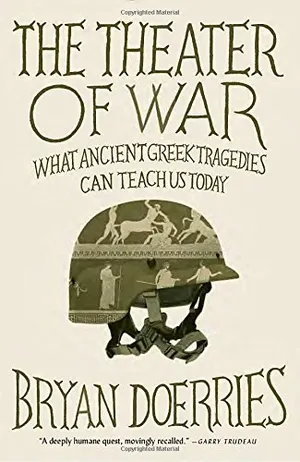
The Theater of War: What Ancient Tragedies Can Teach United states Today
This is the personal and securely passionate story of a life devoted to reclaiming the timeless ability of an aboriginal artistic tradition to comfort the afflicted. For years, theater director Bryan Doerries has led an innovative public health project that produces ancient tragedies for current and returned soldiers, addicts, tornado and hurricane survivors, and a broad range of other at-risk people in order.
"Although I wasn't enlightened of it at the time, witnessing Laura's svelte expiry opened my optics to what the Greek tragedies I had studied in school were trying to convey. Through tragedy, the great Athenian poets were not articulating a pessimistic or fatalistic view of human being experience; nor were they bent on filling audiences with despair. Instead, they were giving voice to timeless human experiences—of suffering and grief—that, when viewed past a large audience that had shared those experiences, fostered compassion, understanding and a securely felt interconnection. Through tragedy, the Greeks faced the darkness of homo existence as a community."
Simply that's the book version. Tidy. Well-considered. The truth of it was messier.
Coming out of graduate school in California, he was scrambling. He had moved to New York and was writing and translating in an apartment above the Tops grocery shop on 6th Street in Williamsburg. Laura had been diagnosed with cystic fibrosis years earlier, and now, after medical interventions, including a double lung transplant, information technology was apparent she wouldn't make it. She fabricated her peace with information technology and shared that peace and for weeks was visited past the people she loved almost, and who loved her. And the experience of her death at the age of 22 was thus somehow touched with joy.
"And the fashion that she died, which could be viewed as very sad, was actually one of the nigh powerful and transcendent and important moments of my life. That anyone could die this way was something I didn't sympathize at age 26. It was a revelation.
"After that experience and caring for my father through his kidney transplant, I started working on Philoctetes and remember writing the chorus in the hospital where my father was recovering, thinking to myself that I'll never get out of the transplant ward of the hospital. And it was dawning on me that the reason I was translating Philoctetes was it was specifically about a chronically sick individual abandoned on an island. And, even more poignantly, about a young person who against his volition, without actually knowing what he's getting himself into, is thrust into this epically impossible situation equally a caregiver. For which there aren't right answers and past which he'due south going to be haunted for the balance of his life.
"What happened was, I call back, precisely what the Greeks were trying to prepare young people for, through tragedy, which is the exigencies of developed life.
"And when Laura died, all I wanted to practise was talk most these big existential things, about death and what I witnessed. I really think that this apparatus that I created is really but a giant pretext to create this space where people will want to talk most this."
This is Doerries' magnificent obsession, the solace of history. Restarting an ancient machine for healing; the living theater as a therapeutic musical instrument.
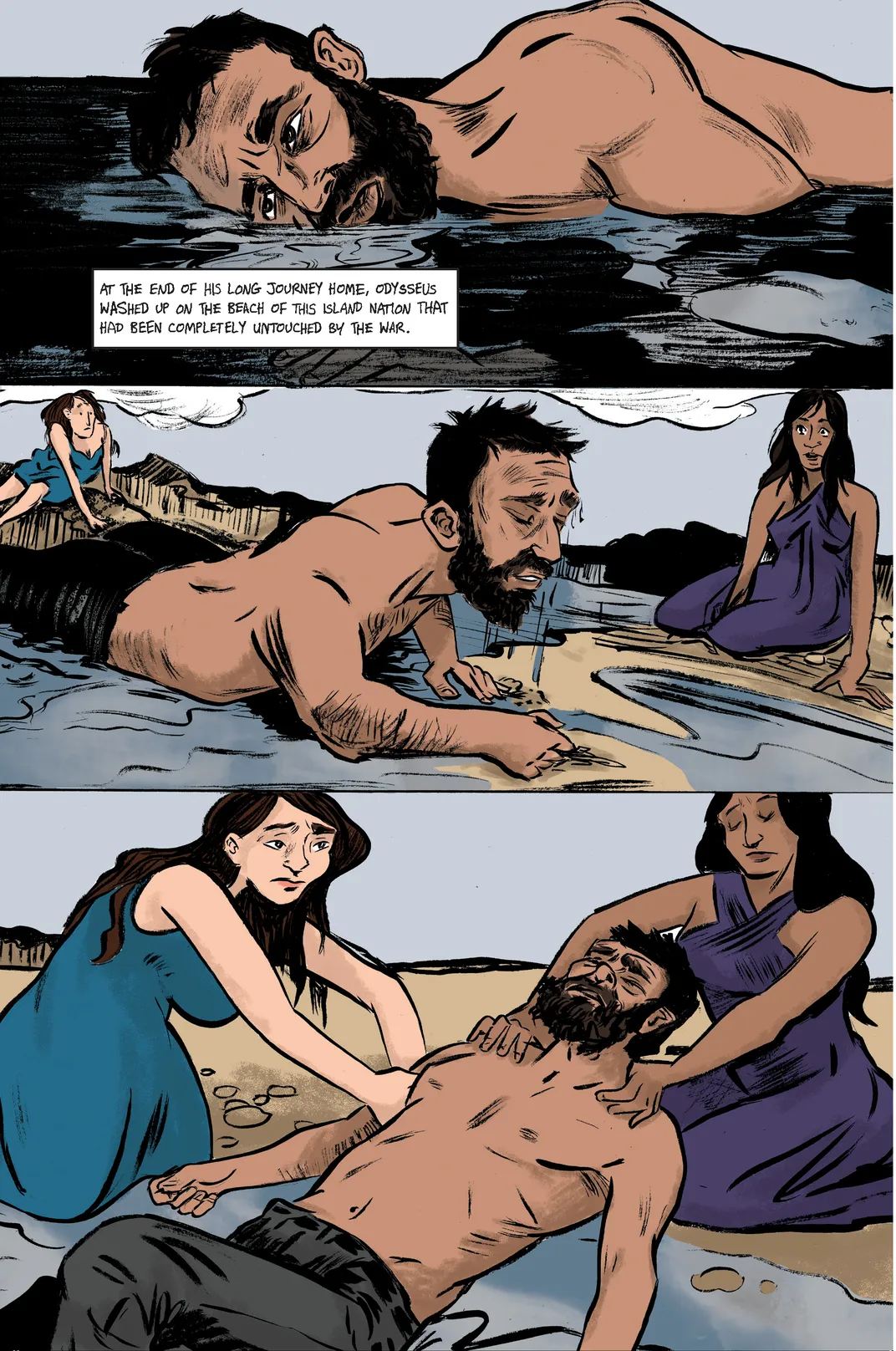
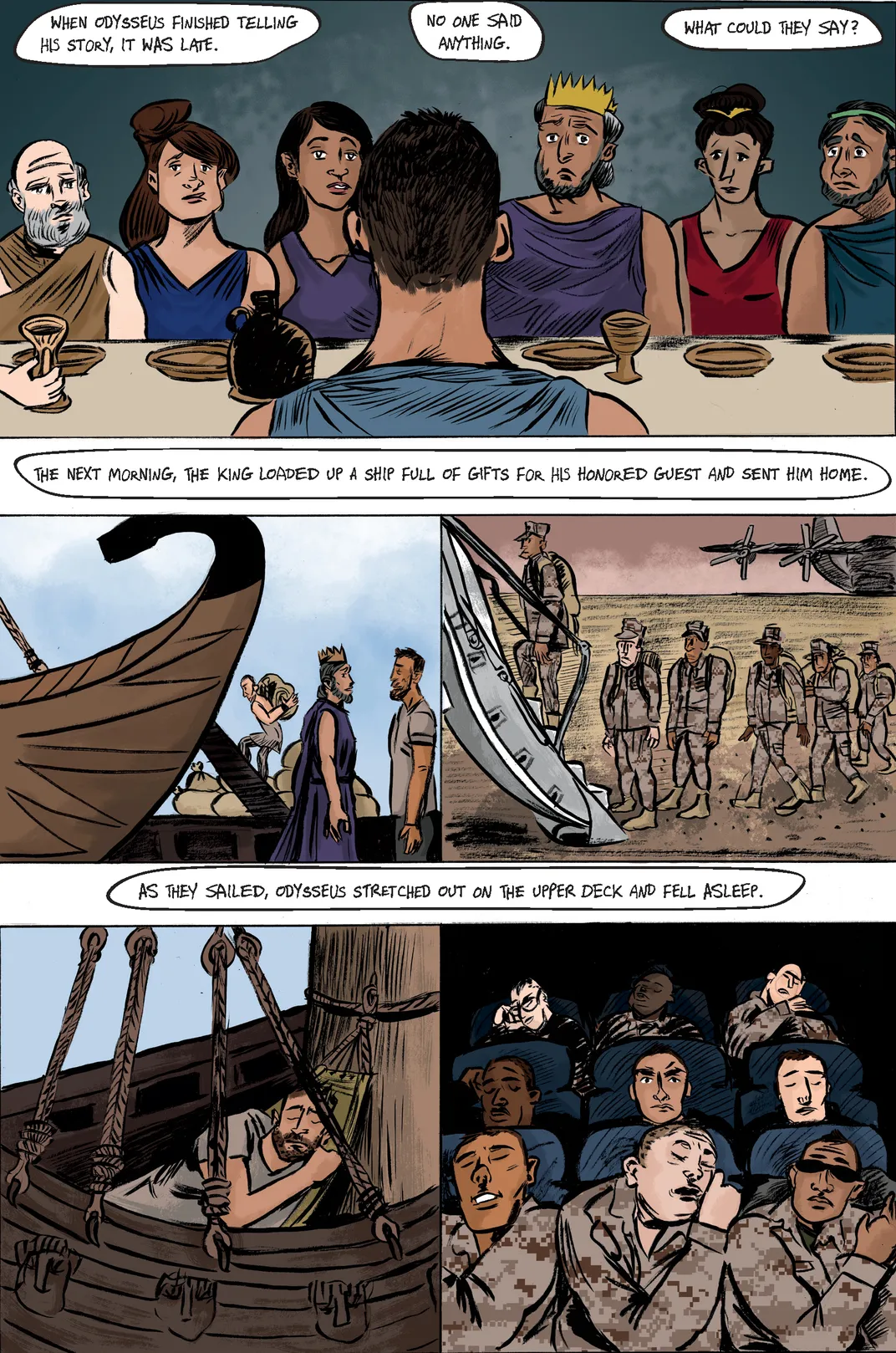
His translations of Ajax and several other approved works of the Greek theater are collected in All That You've Seen Here Is God, also published in 2015. His latest book, The Odyssey of Sergeant Jack Brennan, an updated adaptation of The Odyssey, should probably be in the hands of every soldier everywhere for lessons it teaches about loss, loneliness and post-traumatic stress.
And for a man who spends 100 nights a yr on the road, who has produced and directed hundreds of shows in the last eight years, who has published five books in the last two years, Bryan Doerries does not look fatigued or haggard or tired. Whenever you meet him, Bryan Doerries looks ready.
**********
Past sharing all this, by helping himself, he figures he can help the residuum of us. And that core value of Theater of War is here, in a single line in Ajax, from this early exchange between the chorus and Tecmessa:
TECMESSA
Tell me. Given the pick,
which would
y'all prefer: happiness
while your friends
are in pain or to share in
their suffering?
CHORUS
Twice the hurting is twice as worse.
TECMESSA
Then we'll get sick while he recovers.
CHORUS
What do yous mean? I exercise not follow the
logic of your words.
TECMESSA
In his madness he took pleasance in the evil
that possessed him, all the while afflicting
those of us nearby. But now that the fever has
broken all of his pleasure has turned to pain,
and we are still afflicted, just as earlier.
Twice the pain is twice the sorrow.
CHORUS
I'thou afraid that some god struck him downwards,
for his anguish grows equally his sanity returns.
TECMESSA
It is true, but all the same hard to sympathize.
CHORUS
How did the madness first accept hold of him?
Tell u.s.. We will stay and share in the pain.
"Tell us. We will stay and share in the pain," is the premise for the entire programme, every bit Theater of War's own mission statement makes clear.
"Past presenting these plays to military and civilian audiences, our hope is to destigmatize psychological injury," Doerries tells his audition. "Information technology has been suggested that ancient Greek drama was a course of storytelling, communal therapy and ritual reintegration for combat veterans by combat veterans. Sophocles himself was a general. The audiences for whom these plays were performed were undoubtedly composed of citizen-soldiers. Also, the performers themselves were most likely veterans or cadets.
"Seen through this lens," he continues, "ancient Greek drama appears to accept been an elaborate ritual aimed at helping combat veterans return to noncombatant life after deployments during a century that saw 80 years of war. Plays similar Sophocles' Ajax read like a textbook description of wounded warriors, struggling nether the weight of psychological and concrete injuries to maintain their dignity, identity and laurels."
Theater of War Productions has presented more than than 650 performances for armed services and civilian audiences all over the world, from Guantánamo to Walter Reed, from Nihon to Alaska to Federal republic of germany. Doerries has employed other plays from ancient Greece to serve other purposes every bit well, addressing issues such equally domestic violence, drug and alcohol habit, gun violence and prison house violence. Presentations can be tailored for service members, veterans, prison house guards, nurses, kickoff responders, doctors and police officers.
What the programs practise in every example is crack you lot open up.
Even these minimalist table readings engage people in a way they're unprepared for. "The performances are ever incredibly cathartic," says Chris Henry Coffey, who has collaborated frequently with Doerries. "It touches on something Bryan says, 'If there's one thing y'all take away from this this evening, it's that you are non alone. You're not solitary in this room, not alone in the globe and across miles, and nigh importantly, not alone across fourth dimension.'"
What did Sophocles know that nosotros don't? That drama, live theater, can be a machine for creating empathy and customs.
Emmy winner and Academy Award nominee David Strathairn, lean and quiet and decent, was 1 of Doerries' first actors. "What is extraordinary about what Bryan conceived, and is proven every time nosotros nowadays, is that these plays don't need the accoutrements of a staged production to exist effective. No lights, no costumes, no fix, no musical enhancement. The story is delivered raw and unadorned straight to the ears of the audience. And every bit Bryan has said many times, the existent drama begins once the reading is finished and discussion begins."
Actors are paid a small honorarium, fly economy and stay at the ii-star hotel chains.
"I speak to those who understand!" says Ajax, nearing the end of things. Information technology is the veteran's lament, that the story tin be understood simply by those who have seen the same things. Merely it turns out that's not true; that all of us in the tribe can contribute our agreement equally therapy; as medicine.
What's more heartbreaking even than his acrimony or shame or self-pity is his ambivalence in his final tranquillity moment. Mourning himself already and what he'll get out backside.
AJAX
Death oh Death, come up at present and visit me—
But I shall miss the calorie-free of day and the
sacred fields of Salamis, where I played
equally a boy, and great Athens,
and all of my
friends. I call out to you springs and rivers
fields and plains who nourished me during these
long years at Troy.
These are the last words you will hear Ajax speak.
The residual I shall say to those who heed
in the globe below.
Ajax falls on his sword.
A few seconds afterward, his wife Tecmessa finds him and sets loose her terrible weep. That cry echoes downwardly 2,500 years of history, out of the collective unconscious. Men and women and gods, war and fate, lightning and thunder and the universal in anybody.
**********
The United states has been at state of war for 16 years. Soldiers in the past might be deployed for 100 days or fifty-fifty 300 days in a frontline state of war zone; now they've been downrange ane,000 days or more. Four, 5 or six tours in Iraq or Afghanistan or both. The stresses are unbearable. Armed forces suicide rates have never been higher. A Department of Veterans Affairs study was released in 2016. As reported by theMilitary machine Times:
"Researchers found that the risk of suicide for veterans is 21 percent higher when compared to civilian adults. From 2001 to 2014, as the civilian suicide rate rose about 23.iii percent, the rate of suicide amongst veterans jumped more than 32 percent.
The problem is particularly worrisome amid female person veterans, who saw their suicide rates rise more than 85 per centum over that time, compared to nearly xl percent for civilian women.
And roughly 65 per centum of all veteran suicides in 2022 were for individuals 50 years or older, many of whom spent little or no time fighting in the most contempo wars."
Retired Army Gen. Loree Sutton, a medical dr. and commissioner of the Department of Veterans Services for the urban center of New York, was an early advocate of Theater of War.
"I had been through so many lamentable training sessions with PowerPoint slides. We had to have something that would actually engage our troops and their leaders. An experience that really spoke to their inner fears, needs and struggles.
"I starting time met Bryan at the Defense Centers of Excellence countdown Warrior Resilience Briefing in 2008," recalls Sutton. "It was Elizabeth Marvel, Paul Giamatti and Adam Driver for that initial performance. I was diddled abroad. 1 officer told me—I'll never forget this—he had recently lost a buddy to suicide. He said, 'I simply know...I just know my buddy would be here today if he had seen that y'all can have these feelings, these struggles and you lot can all the same be the strongest of warriors.'"
"I really took that equally an endorsement of Bryan'due south model," adds Sutton. "I started talking to Bryan and trying to figure out, how could nosotros bring this to scale throughout Department of Defence force? Against all odds, we were able to negotiate a contract with DoD. This has led toAjax beingness then broadly shared in so many unlike settings and groups."
But that initial contract funding has now run out. The challenge for Doerries is raising not only awareness but coin. And at a fourth dimension when veterans are beingness asked to return their re-enlistment bonuses, that's no easy task. According to the Pentagon, the Pentagon is strapped.
"Theater of War has been part of my journeying," says Lt. Col. Joseph Geraci, co-founder of the Resilience Center for Veterans & Families, a privately funded initiative at Columbia Academy. "It's the therapy I've received in its cathartic moments that help me feel continued to the person to my left and my right.
"My purpose is to help others heal," he says. "I even so get goose bumps whenever Bryan mentions that the intent of the evening is to afflict the comfortable and comfort the afflicted."
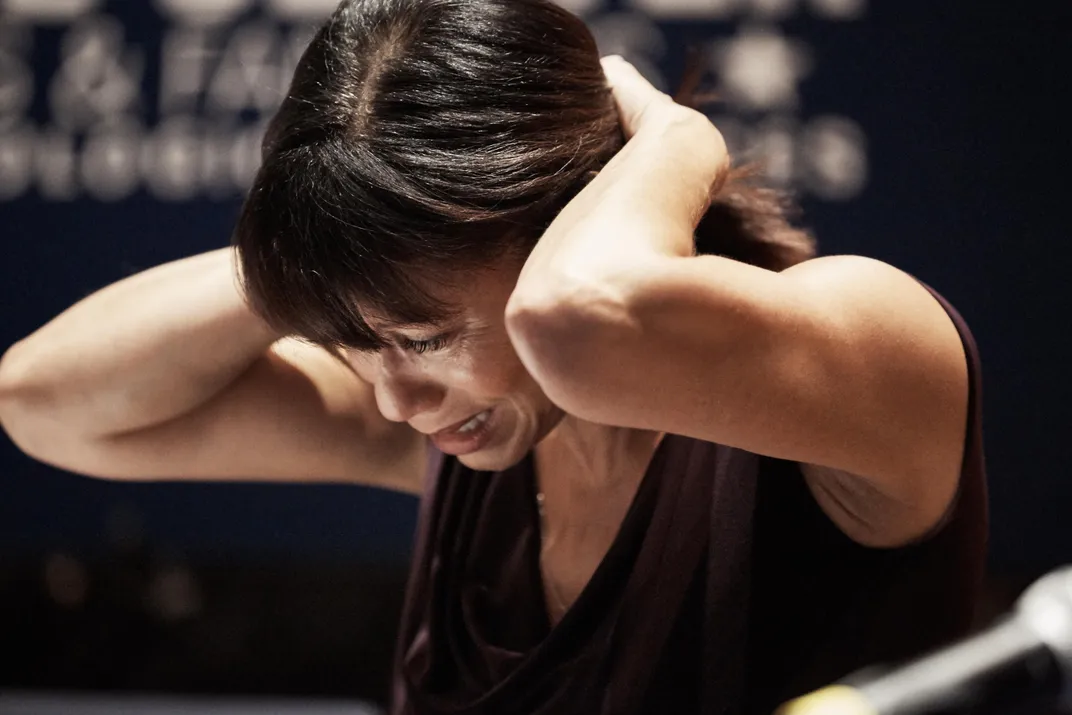
"No one gets closer to a text or the impulse backside the linguistic communication itself than actors and an audience," Doerries says. He directs at only one tempo,prestissimo. Performed at Doerries' ideal pace, it's near anti-theatrical: the urgency has a footing in brain chemical science. The discomfort he seeks triggers the fight or flight machinery in the listener, heightening not only their dramatic apprehensions but their senses. Their attention. Their retention. Y'all walk out of the all-time of these shows exhausted.
And perchance yous'll walk somewhere to go help.
The show is not a talking cure. It is not an terminate in itself.
It is the beginning. And right now someone somewhere needs them. Needs this.
**********
That'southward how they got to Ferguson, Missouri.
On August 9, 2014, Michael Brownish, xviii, was shot to death during an altercation with police officer Darren Wilson. Ferguson became synonymous with violent unrest and militarized police, with Black Lives Matter and new social justice and onetime urban stereotypes of u.s.a. versus them. The very name Ferguson, like Watts or Newark or the Lower Ninth Ward, became a sound bite, another autograph for injustice and struggle, for a gear up of seemingly stock-still assumptions virtually America and Americans.
Theater of War arrives trying to modify that.
"When Michael Brownish died," Doerries says, "Christy Bertelson, the head speechwriter for Governor Jay Nixon, called me to see if I could think of a play that would aid. Eventually I proposedAntigone. It was Christy who suggested nosotros set the choruses to gospel, and then I insisted that we build a choir that included police singers."
Landing in St. Louis, Doerries is tired. He is also hungry. He is also on his phone. He answers questions as he walks, his rolling baggage at his heels like a devoted family pet. In other words, he is as he always is. Gorging, and in motion.
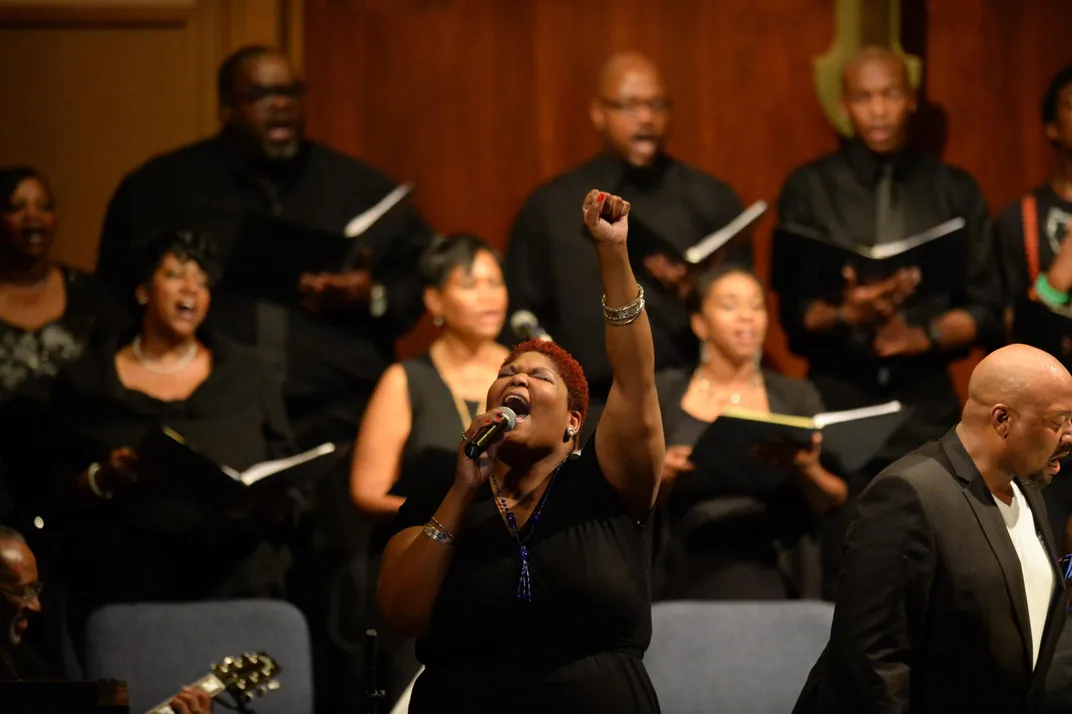
The Greek chorus will be played by an all-star gospel choir from several area churches, a youth choir, and the St. Louis Metropolitan Police Department Choir. The music has been composed by Phil Woodmore, a local music teacher and musician and vocalizer of renown. "I created all five of these songs based on the flow of the story and the text that Bryan had given me. Fifty-fifty in the challenge of it, in that location was so much structure around it. Then there was still a safe zone there for me."
Reg E. Cathey ("Business firm of Cards," "The Wire"), with the voice of an Old Testament prophet, volition strut and fret as Creon. At rehearsal in a classroom at Normandy High School, extra Samira Wiley (Poussey Washington in the Netflix series "Orange Is the New Black") is as fierce as Antigone must exist. In the scene when she is told that she'll never become where she wants to go, her delivery of the line "So I shall die trying" brings non but chills but tears. Even the Tv set news crew in the room is brought up short by it.
Glenn Davis ("Jericho," "The Unit," "24," Broadway) and Gloria Reuben ("ER," "Mr. Robot") will play a multifariousness of roles.
There volition be three performances in a single mean solar day. I at Normandy High School, two more at Wellspring Church. Understand showtime that Ferguson isn't a war zone. It's a St. Louis suburb of mixed incomes, mixed outcomes, mixed demographics. Wells-Goodfellow, the neighborhood down the route by the loftier school, isn't a war zone either. It'southward what a metropolis looks similar after the war is lost. Picture Berlin in 1950 black-and-white. The debris has been bulldozed and what's left is a tidy grid of generally empty buildings and lifeless sidewalks.
It's an apt setting forAntigone. It's a play near violence and say-so and sadness and about the loftier price of principle and the incommunicable cost of weakness. Information technology's a play about an unburied body.
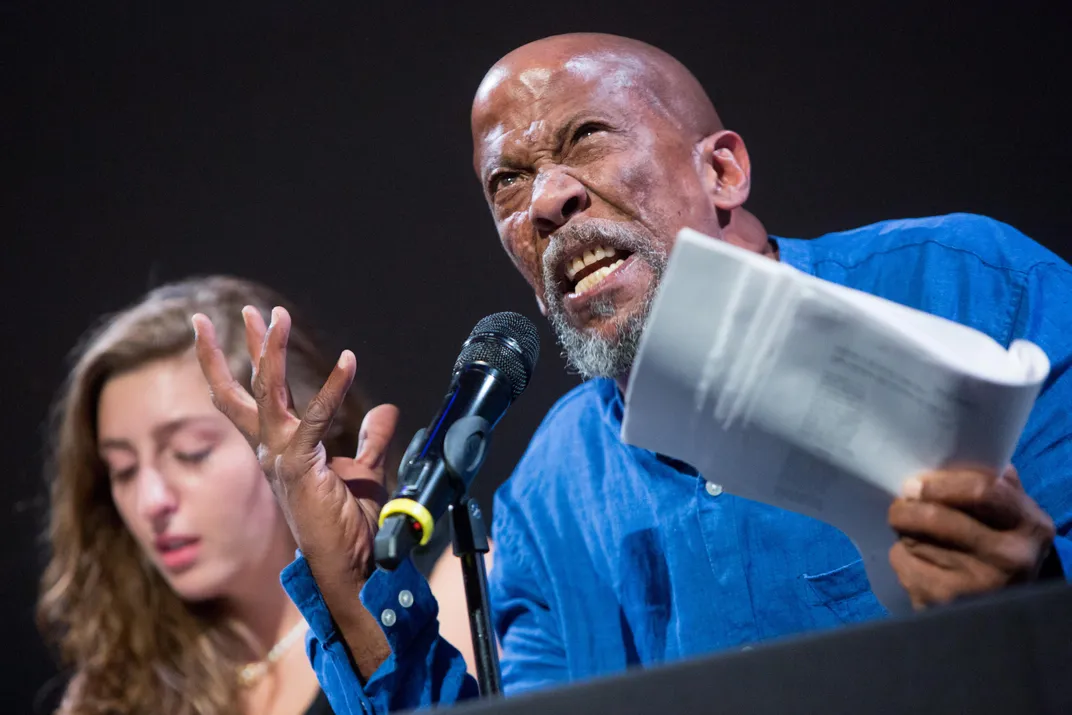
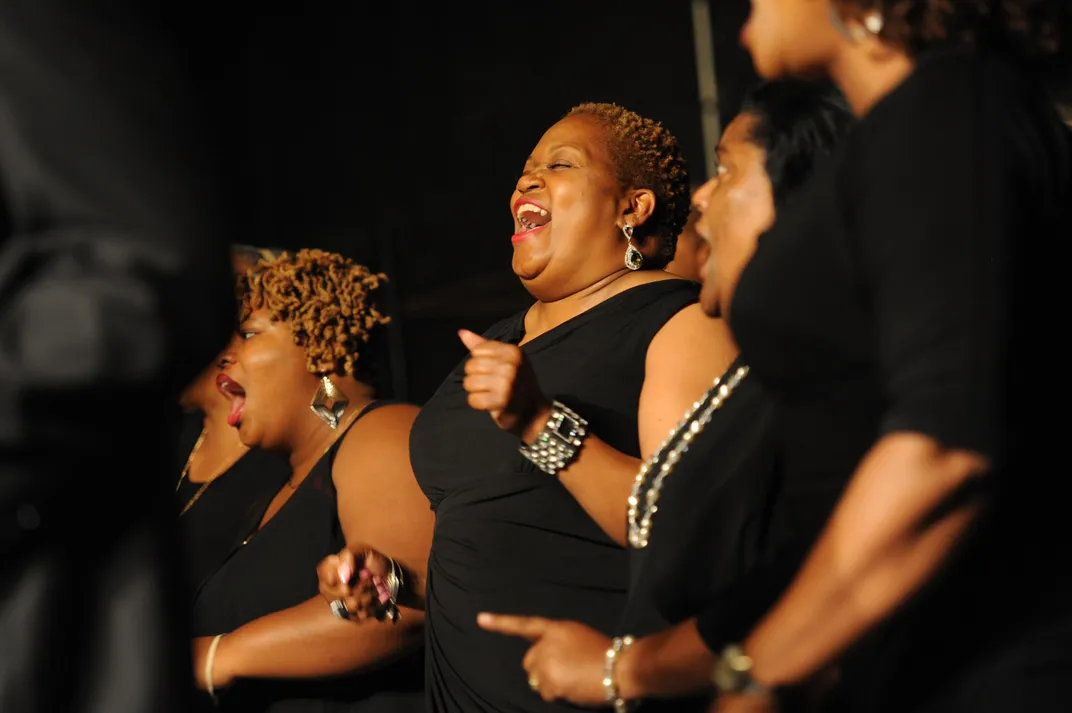
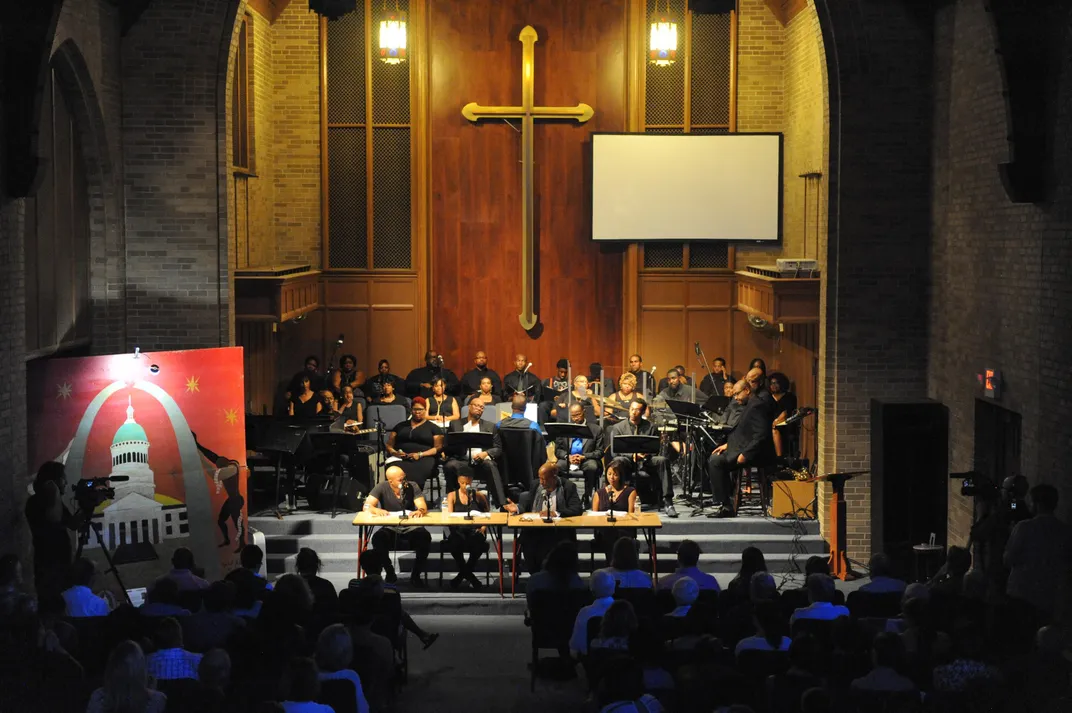
A terrible ceremonious war has just concluded in Thebes. Antigone's brothers have killed each other and died in each other's arms. Creon has taken the throne and ordered the rebellious brother, Polyneices, exist left to rot unburied. Defying that gild, Antigone rushes to bury him.
CREON
Tell me—and be careful with your words—
were you enlightened of my proclamation forbidding
the body to be buried?
ANTIGONE
Yes. I knew it was a law-breaking.
CREON
And you still dared to break the law.
ANTIGONE
I didn't know your laws were more powerful than
divine laws, Creon. Did Zeus brand a proclamation,
likewise? I wasn't about to break an unwritten rule of
the gods on business relationship of one human'southward whim. Of course,
I knew I would some day die. And if that day is
today, then I count myself lucky. It is better to dice
an early death than live a long life surrounded by
evil men. Then don't wait me to go upset when you
judgement me to death. If I had immune my ain brother
to remain unburied, and then you might see me grieving.
What'south incorrect? You seem puzzled. Perhaps you call up
I've rushed to action without because the
consequences? Well, maybe it'due south you who has rushed to
action. Either fashion, the question remains: Do y'all have the guts
to follow through?
CREON
I run across you've inherited your begetter'south charm.
Citizens, I say that she is a man and I am not,
if she gets away with breaking the law and boasting
well-nigh her crime. I don't intendance if she'south my niece, she
and her sis will both be put to death, for
I hold her sis equally responsible for planning
this burying. Call her. She's right within. I only saw
her running around the palace in hysterics.
Creon orders Antigone put to death, walling her up in a small cavern where she eventually commits suicide. Equally does Creon's ain son, betrothed to marry her. Then Creon's wife, when she learns of her son's death. It is a chain of tragedies forged by Creon's own stubbornness.
Antigone wants only to do what's right, bury her brother. Creon wants only to do what's right, preserve civic order. Information technology's a play, as Doerries instructs the audience, "most what can happen when everyone is right."
The breakneck pace of these readings gives the events of each play a drumbeat not only of urgency but of inevitability. The price of proficient fortune is calamity, and information technology is swift-moving and information technology is inexorable, and as the chorus says, destiny can be avoided, but information technology cannot exist escaped. Fate is a one-runway, high-speed train wreck, and for the audience, this means a swift rush of endorphins.
The translations are office of the effect and the program's success, too. Nigh textbook translations of these Greek classics, the ones dreaded past high school students, read like a 19th-century catalog of waxworks. Here'southward Ajax, perfectly preserved and standing absolutely still; here's Odysseus, here's Achilles. The heroes cast shadows, only zip moves. More devoted to scholarship and preservation than the imperatives of living theater, the whole thing is inert on the page. Fifty-fifty the all-time modern versions lose dramatic momentum in the bogs and thickets of their own verse.
But every Doerries translation is a hot rod. A souped-up, stripped-down engine of upshot. Behavioral rather than aesthetic, each ane is a principal form in compression; in conflict and climax and American colloquial English. Lives are ruined and race to their inevitable end without the ornamentations of poetry. "To me it's 1 thing. Directing and translating are ane thing." The last few lines ofAntigone illustrate the bespeak.
Creon has been destroyed by fate, by his own convictions and decisions. He begs to be led away from the urban center.
The Doerries translation, spare and unsentimental, is a punch in the face.
CREON
Atomic number 82 me out of sight, please...I am a foolish man.
At that place'south blood on my hands. I killed my married woman and kid.
I am crushed. I have been crushed by fate.
exit Creon.
CHORUS
Wisdom is the greatest gift to mortals. The grand
words of proud men are punished with cracking blows. That
is wisdom.
At the moment of that last line the theater is hushed with a terrible truth.
And information technology arouses in people the willingness to rise and speak and to share their suffering.
One of the singers, Duane Foster, a speech and drama teacher, is besides a panelist, and taught Michael Brownish. He leans into the microphone and his anger is non measured, it is righteous. "So many people look at the bodily human activity of the shooting. People forget about the total breathy disrespect of that boy laying on the ground because people were trying to figure out what to exercise."
What does Sophocles know that we don't?
"You are standing in front of people," Samira Wiley told a film coiffure from PBS after the operation. "You are looking at people who were in this young man'southward class, people who were his educators. And what we practice, at the end of the day, is fake. It's—nosotros're acting. Just nosotros tin can elicit real, emotional human feelings from people. And one matter that Bryan Doerries told me was that information technology's not so much about what nosotros can give them, simply what they can give us. And yous tin can hear that in theory, but I actually experienced that today."
Two shows at the church in the heat, the music rising, the audience taken up, cops and customs, the intimacy and the ardor and yes, the dear, even in dispute or disagreement, anybody for everyone, neighbors once again, and so sweetly, then briefly, unopposed. All the sweat and ecstasy and chain lightning of an quondam-fourth dimension revival meeting.
"Information technology was this amazing little moment, both artistic and communal," Reg E. Cathey says. "Black people, white people, old people, young people. It was 1 of those things that make you glad to be an American in a weird manner."
"When I had my first rehearsal with a choir, I felt this was working, but I did not expect that level of a response," Phil Woodmore said. "I knew that what I had created was a very well-packaged product that people could appreciate, but I did non know how overcome people were going to be."
Late that dark, even an exhausted Doerries is overwhelmed. "Information technology was more than I had imagined for it," he said, "Even after rehearsal I couldn't know what that music would practise to an audience. Amazing. Now we accept this evidence on to Baltimore and New York."
Beyond class war and political resentment, beyond even racism, there is something greatly lonely in modernity, something isolating and dislocating. Maybe sitting in the same room with other humans who suffer and speak is condolement enough. Maybe plenty to save united states.
The next morn, sunrise early, vocaliser John Leggette, a police officer who performs as a soloist in the chorus, is back in compatible. But his heart is even so on stage.
"That was awesome," he says, smiling and shaking his head and walking slowly to his team car. "Crawly."
**********
A few months later, in the auditorium of the National Geographic Order in Washington, D.C., sit the chairman of the Joint Chiefs of Staff and the Secretary of the Section of Veterans Affairs.
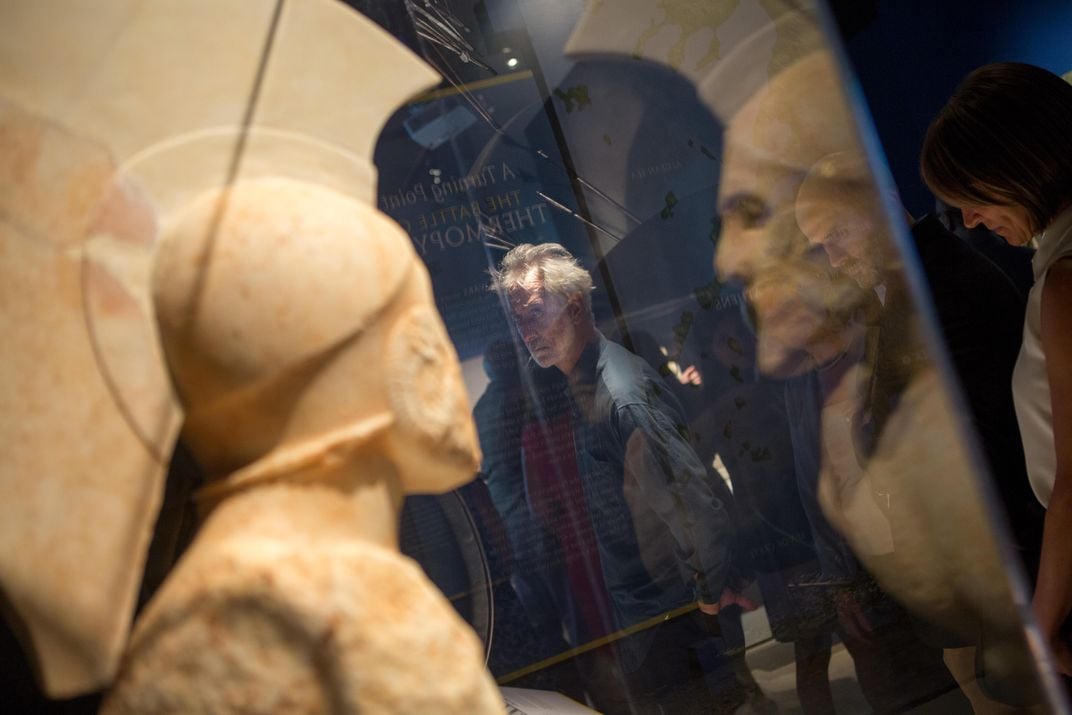
Before the performance, the actors walk through a touring exhibition of Greek antiquities in the National Geographic Museum. David Strathairn spends a long moment looking hard at a not bad hammered disk of gilt. The face up on the disk is his own, straight-featured and serious. "Well, let's just say that seeing the Mask of Agamemnon before reading a play written 2,500 years agone that speaks straight of that fourth dimension in history, to a room total of people intimately acquainted with what it ways to be a warrior, was a pretty heady experience. Time dissolved for a moment—The 'hither and now' met 'the so and at that place.'"
One of the leads, Jeffrey Wright, isn't here yet. His aeroplane is late. He'll go far at 5:05 for a 5 o'clock evidence.
For the other actors—Strathairn in the role of Philoctetes, Cathey as Ajax and Marjolaine Goldsmith as Tecmessa, his wife—the instruction in rehearsal remains the aforementioned: Brand the audience wish they had never come.
And once more Tecmessa begins,
Oh, you salt of the Earth, y'all sailors who serve Ajax,
those of us who care for the house of Telamon will presently
wail, for our fierce hero sits shellshocked in
his tent, glazed over, gazing into oblivion.
He has the thousand-yard stare.
CHORUS
What terrors visited him in the night
to opposite his fortune by morning?
Tell us, Tecmessa, battle-won bride, for no one is
closer to Ajax than you, so you will speak every bit one
who knows.
TECMESSA
How can I say something that should never
be spoken? You would rather die than hear
what I am about to say.
A divine madness poisoned his mind,
tainting his proper name during the night.
Our dwelling is a slaughterhouse,
littered with cow carcasses and goats
gushing thick blood, throats slit,
horn-to-horn, by his hand,
evil omens of things to come.
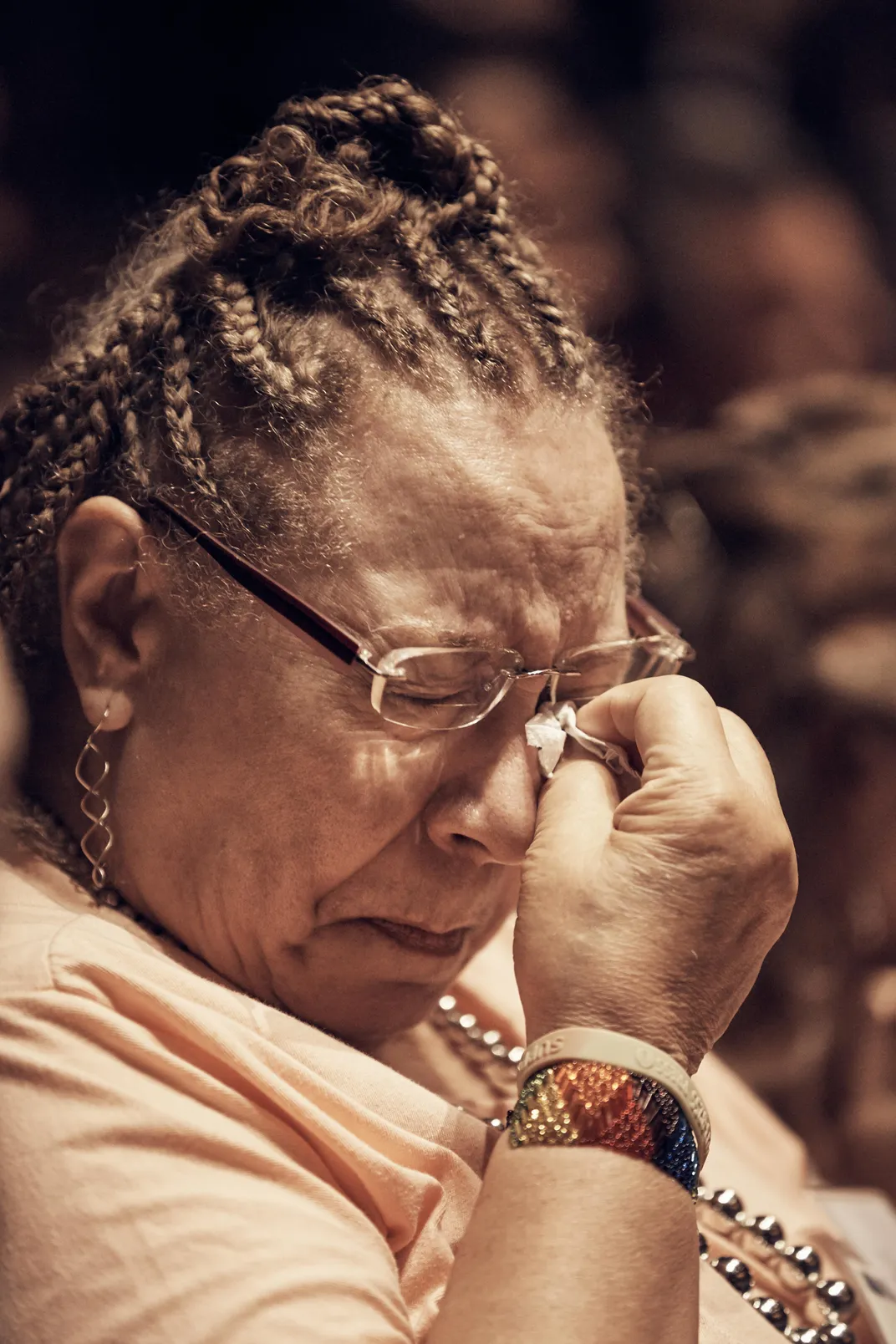
"Our home is a shambles," is the line that war machine wives and husbands in the audition and on the panels most ofttimes mention, the one that cracks them open with a terrible recognition. The play is as much about the challenges facing the spouses, the families, equally information technology is about the wounded fighter, the isolated, brokenhearted hopeless.
So into this sedate woods-paneled room are beckoned all the horrors of war. Doerries, in a dark, well-cutting suit, is upward and down the aisles with a microphone equally soon every bit the reading is over.
He asks the audition a question about Ajax: "Why exercise you call up Sophocles wrote this play?" And so he tells a favorite story. "I asked that question at one of our kickoff performances and a young enlisted man stood up and said, 'To boost morale.' And I thought, 'That's crazy' and I asked him what could perhaps exist morale-boosting about a great warrior descending into madness and taking his own life?
"'Because it's the truth,' he said. 'And we're all here watching it together.'"
Joe Geraci is again on the panel here, and tells a wrenching story. "In 2007, in July, I buried one of my best friends in Arlington. The hardest thing for united states of america that 24-hour interval was that every single one of us would have given our life if Tommy could have come dwelling house alive. I haven't been back there in about 9 years. And then today I went to Section 60. I placed one of my battalion coins on his gravestone and I was weeping and I looked upwardly and saw another 1 of my shut friends, who was also in Section lx—he was i of my bunkmates during my final deployment to Transitional islamic state of afghanistan—and we merely embraced. We simply embraced for similar v minutes. No words exchanged. And I'yard recalling Tecmessa's message of, 'We'll get sick while he recovers,' so undoubtedly me and Bryan got a little sick today, and I know my parents got a picayune sick today, but I was able to heal."
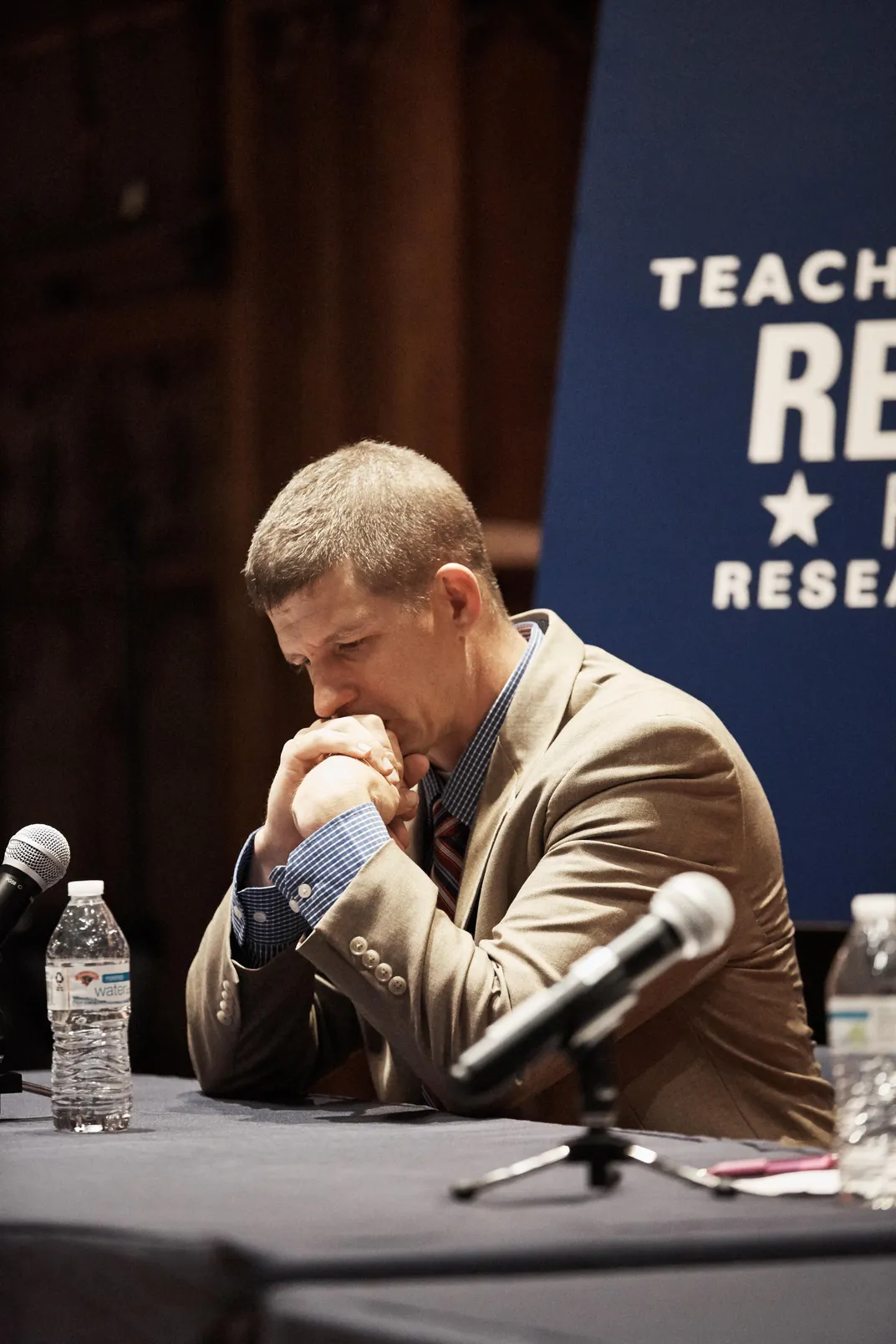
And so a man rises in the audience and takes the microphone and says in a soft voice, "First I want to give thanks the actors and give thanks our console members. My name is Lieutenant Colonel Ian Fairchild. I'm a C-130 pilot. I have flown in Afghanistan and Republic of iraq. To answer your question, 'Why do they take information technology to that extreme, 15 or twenty minutes of wailing?' I think that he probably did it that way because that'due south the simply way, comparatively, for his audience, information technology must have seemed awful, and horrible, and that actually would have brought the bulletin home. But for the people who have served, it probably did not compare on whatever level. And then personally what really struck me about the wailing is that more than powerful than wailing is the silence that covers you when y'all come to your shipping and y'all meet an American in a flag-draped casket and you accept to wing them habitation in silence. That to me is more powerful than whatsoever scream. So, thank you very much for the performance this evening and for the chance to have this chat."
And the room goes quiet for what feels like a very long time.
**********
After the show, at the reception, vets from the audience were still thinking and talking about what they'd seen. It'south a start. Not an end.
How do we reintegrate our soldiers—and ourselves—into a healthier order?
To say that the outcome is cathartic or therapeutic is to understate things past an order of magnitude. Those screams. The human agony. The effect is that of being divide downwardly the eye, not at the weakest parts of yourself, merely at the strongest. Things pour out, and things pour in. It is a machine for healing, for making empathy.
The quality of the performance, yet superb, is secondary. The word is why these folks are here, and that risk for healing and connection and intimacy. Become ofttimes enough, long plenty, and yous'll run into soldiers ascent in tears, and husbands speak of wives, and sons and daughters tell the stories of their mothers and fathers.
A calendar month after the presentation at National Geographic, the then Secretarial assistant of the Section of Veterans Affairs, Robert A. McDonald, who was seated in front that night, tells Doerries that he thinks there's a fashion to scale Theater of State of war into a national plan. The Veterans department is probably where it belongs. But Washington is a wheel that grinds slow, and anything can still happen. But "this bodes well," Doerries says, "and this just adds to our groundswell of momentum."
In addition, Doerries has proposed that the Department of Defense consider an initiative to provide newly inducted members of the military with a copy of Doerries'The Odyssey of Sergeant Jack Brennan. The graphic-novel retelling ofThe Odyssey by a Marine sergeant to his team the night before they rotate stateside, succeeds as art and education. It is a primer on the struggle and isolation every soldier since the kickoff of fourth dimension has faced on the way home. It connects soldiers not only to the experience of war but to its psychological costs and to history itself.
Today, however, when spending cuts may loom, even pop projects lose momentum. Who'south in, who's out, who'll write the checks? And information technology'due south the same at Veterans Diplomacy as at the Defense force Department. What the future holds for large-scale implementation of the books or workshops or performances is unknown.
A Theater of War performance, Doerries says, would be held "for all the Joint Chiefs and the Secretarial assistant of Defense and everyone below them, which would be hosted past the chairman and his top staff." The date for the result was set for October 4 at Fort McNair in Washington, D.C.
**********
A few months after the original Ferguson production, another performance of what is now calledAntigone in Ferguson was mounted in New York Metropolis, in the atrium of a skyscraper on Fifth Artery. Near of the singers and performers are the same, simply the setting couldn't exist more dissimilar. The night is part of the Onassis Festival NY, "Antigone Now," a celebration of Greece and Greek culture and history produced by the Onassis Foundation.
The space is a cake long, tall and narrow, hung with lights and speakers and temporary staging. Sound ricochets off everything. In that location are chairs for 100 audience members and continuing room for a few hundred more. The oversupply is a New York City mix of men and women of all ages and colors and classes and languages. The choir is off to ane side, rather than behind the actors, and once the singing starts, the entire atrium is filled with music. And before the dark is over, you'll see the panelist who hates police, who fears for the lives of her blackness sons at the hands of police, assemble upwardly the police lieutenant in her arms and non allow go.
Again, Samira Wiley is fierce equally Antigone. Actors Glenn Davis and Gloria Reuben are grounded and honest; they bracket Reg E. Cathey as he roars and gets steamrolled past fate. Over again, the music soars. Once more the night is ecstatic in the truest sense, most hypnotic, with the spirit in words and music moving through everyone. Just even in this sanitized corporate setting, once the discussion starts the tension is betwixt promise and hopelessness.
"What are the effects of segregation on policing?"
"What most cease and frisk?"
"How do you defend what is obviously wrong?"
And again, Duane Foster is agog, and Lt. Latricia Allen is the reasonable voice of responsible policing. She doesn't believe in the blueish wall of silence. "I have to be the change I want to see," she says. "I don't go along with the okey-doke."
The discussion goes on and on, about the nature of respect and boldness; about the relationship between police and the people they're meant to serve; about parents and violence and politics and fear and beloved.
Doerries reminds everyone that tonight is merely a showtime; they'll behave the conversation out into the wider world. One of the last questions is one of the simplest. And most complicated. "I'm African-American," a adult female says in a level tone that rises in the polite silence. "How are we supposed to live?" And for a long time that question sifts down over everyone. It is the question at the centre of everything. And for a while the console gives well-meaning answers touched with optimism, but the question is too grave, besides planetary. The answers wander and stop.
How are we supposed to live?
Then Duane Foster leans forwards.
"Shit ain't right," he says finally, decisively, "but you lot tin't give up. The God I serve does really weird things to brand a bespeak."
And the room fills with applause.
A few days later, Bryan Doerries will say the actors and the panelists and the musicians and the members of the chorus "were delighted to discover that we had the power to turn even a corporate antechamber into a church."
**********
In the meantime,Antigone in Ferguson is for the moment a fully funded hit, a delinquent success from Baltimore to Athens, Greece, underwritten in role by Doerries' contempo appointment as a public artist in residence for the New York City Section of Cultural Diplomacy. Operating for the next couple of years on a grant of $1.365 million donated by the Stavros Niarchos Foundation, Doerries sees the sudden and unexpected popularity of this show as a first step toward a more permanent home for Theater of War performances.
"The adjacent phase of this project is to resocialize audiences to expect something different of the theater," Doerries says. "Information technology's really turning New York City into this laboratory, and so it'due south kind of a dream come true."
In that wayAjax begetsPrometheus begetsMedea begetsHercules in Brooklyn, taking Euripides into the streets to talk about gun violence. And also new for 2022 isThe Drum Major Instinct, some other show with a gospel choir and a score past Phil Woodmore. Based on one of the Rev. Martin Luther Male monarch Jr.'s final sermons, the production wrestles questions of racism and inequality and social justice.
So the success of itsAntigone is pushing other Theater of War productions into the cities and neighborhoods where they're needed most, into the libraries and shelters and housing projects and community centers, into the lives of audiences in real need of their aboriginal message of consolation, reconciliation and hope.
The future of the past is vivid.
**********
Out of suffering, hope. Maybe that's what Sophocles knows—that Ajax and Tecmessa and Creon and Antigone suffer and speak for us all, then that we too might suffer and speak.
Twenty-five hundred years afterwards, that terrifying cry comes back to y'all not only every bit an echo through time, or a theatrical antique, simply as an expression of new grief and fresh loss as about and familiar as your own vox. Considering it is your own voice.
"Brand them wish they'd never come up."
But here we are. Every one of u.s.a..

Source: https://www.smithsonianmag.com/arts-culture/healing-power-greek-tragedy-180965220/
0 Response to "Ancient Greece Drama How It Traslates Into Art Today"
Post a Comment